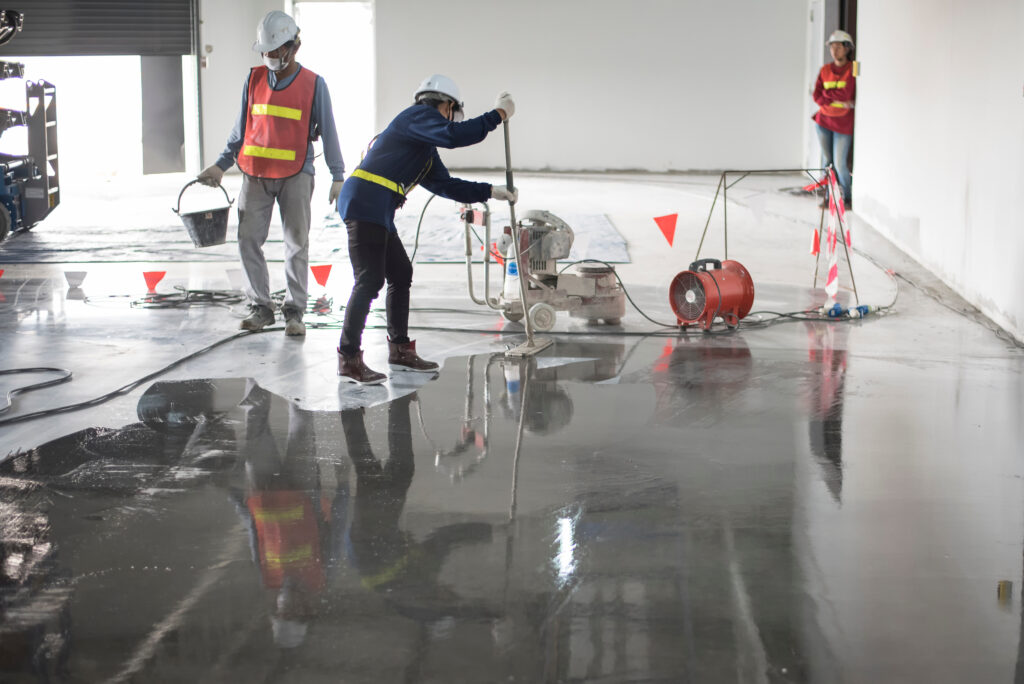
A successful plant shutdown floor recoat depends on far more than selecting the right coating system. Material lead times, substrate testing, repair planning, crew coordination, and cure schedules all influence whether a facility restarts on time or experiences costly delays. For most manufacturing facilities, the shutdown window is the only opportunity to complete a full floor restoration without disrupting operations, making planning essential.
A typical plant shutdown floor recoat covering 10,000 to 20,000 square feet generally requires five to ten calendar days; however, the exact timeline depends on the condition of the existing floor, required repairs, environmental conditions, and the resin system being installed. Developing an accurate epoxy recoat schedule several weeks before the shutdown allows contractors to coordinate materials, moisture testing, surface preparation, and application sequencing while minimizing industrial flooring downtime. When these tasks are planned, a resinous flooring turnaround can often be completed within a standard one- or two-week maintenance shutdown.
For more than 35 years, ASTC Polymers has manufactured epoxy, polyaspartic, and polyurea flooring systems in Santa Ana, California, supporting industrial contractors and facility managers with products designed for efficient installation and long-term performance. Whether you’re planning a scheduled maintenance outage or a complete plant shutdown floor recoat, our team can help you select the right system and develop a realistic installation timeline before work begins.
Why a Shutdown Window Is the Right Time for a Full Recoat
Industrial flooring downtime is expensive in any month, which is why so many facilities patch instead of recoat. Patching has its place, but a worn resinous floor is more than a cosmetic issue. OSHA’s walking-working surfaces standard requires floors to be kept clean, dry where feasible, and maintained in good repair. Exposed concrete in a wet or chemical-exposure area could violate all three.
A scheduled plant shutdown floor recoat lets you do the job properly. Equipment is idle, racking can be moved, and the crew can grind, repair, and coat in continuous phases instead of working around second shift. That continuity matters, because resinous systems bond best when each coat goes down inside its recoat window. The recoat window is the window of time in which the previous layer is cured enough to walk on but still chemically ready to accept the next coat. Miss that window, and the crew has to sand and re-prep, which burns valuable time.
Building a Plant Shutdown Floor Recoat Timeline That Holds
Six to Eight Weeks Out
Walk the floor with your applicator and map the scope. Note bare zones, spalled joints, trench drains, and any areas with chemical damage. Schedule moisture testing on the slab now, not during the shutdown, because elevated vapor readings may require a moisture-mitigating primer, which affects both budget and timeline. This is also the moment to lock in materials. Confirm quantities with a cushion for repairs, and confirm lead times in writing. Because ASTC manufactures in Santa Ana, Southern California plants can often arrange local pickup or same-day shipping, which turns a mid-project shortage from a schedule killer into an errand.
Two Weeks Out
Finalize the day-by-day plant shutdown floor recoat plan with your contractor. Assign who moves equipment, who locks out utilities in the work zone, and who signs off on each phase. Order extra repair mortar and joint filler now. Nearly every shutdown floor uncovers surprises once the old coating is ground off, and material sitting on a shelf is cheaper than a crew standing idle. It’s the least glamorous part of a resinous flooring turnaround, and often the most decisive.
The Shutdown Itself, Day by Day
A typical resinous flooring turnaround for a mid-size production area runs generally consistently. Day one: clear, grind, and vacuum the slab, then complete crack and joint repairs with fast-setting polyurea or repair grout. Day two: prime, addressing any moisture mitigation. Days three and four: apply the body coats, whether that’s a 100 percent solids epoxy or a cementitious urethane in heavy-duty zones. Day five: broadcast non-skid media where you need traction and apply the topcoat. That leaves days six and seven as cure time and buffer. If your window is shorter, fast-cure epoxies and polyaspartic topcoats can meaningfully shorten curing time.
Choosing Chemistry That Shortens Your Epoxy Recoat Schedule
The single biggest lever on industrial flooring downtime is the chemistry you specify, so it’s worth understanding the tradeoffs in plain terms. Selecting the right combination of products early in a plant shutdown floor recoat helps shorten cure times while keeping the installation on schedule.
Standard 100 percent solids epoxies build thickness economically and resist chemicals well, but they cure at a measured pace. Many accept foot traffic within about 72 hours, while full chemical and abrasion resistance develops over five to seven days. Fast-cure epoxy formulations tighten those intervals so crews can recoat the same day. Polyaspartic topcoats cure faster still, often tolerating foot traffic within roughly 24 hours, and hold their gloss under UV exposure near dock doors and windows. Polyurea joint fillers and repair products set in minutes to hours, which is why day-one repairs don’t stall the whole job.
Most successful shutdown floors combine these: an epoxy body for build and chemical resistance, capped with a polyaspartic wear surface for speed. This layered approach is a common specification for a plant shutdown floor recoat because it balances long-term durability with a faster return to production. You can compare primers, epoxies, polyaspartics, and polyureas side by side on our products page, and our team will help you match a system to your traffic, chemistry, and timeline.
What August Heat in Southern California Does to Your Timeline
An August Plant Shutdown Floor Recoat in Santa Ana or anywhere inland comes with a variable many schedules ignore: heat. Warm material and a warm slab speed up everything, and not always in your favor. As a rule of thumb, every temperature rise equivalent to 10 degrees Celsius can cut a mixed epoxy’s pot life roughly in half, so a batch that gives the crew 30 usable minutes in spring may give 15 in an un-air-conditioned plant in August. Experienced crews adapt by mixing smaller batches, spreading material quickly into thin films, cooling components before mixing, and scheduling pours for early morning. The upside is that cure times shorten too, which can actually help a tight resinous flooring turnaround. Our guide to epoxy cure time and pot life walks through the numbers in more depth.
Plan ventilation as well. Even low-odor systems need airflow, and August heat makes fans and cross-ventilation part of the schedule, rather than an afterthought.
Frequently Asked Questions
Yes. Phased installation splits the floor into zones, coating one while production continues in the others, with each zone typically out of service two to four days. It stretches the overall project but limits industrial flooring downtime to one zone at a time, and it’s a common approach for facilities that never fully close.
Foot traffic usually resumes within one to three days depending on the system, but rubber-wheeled equipment needs longer cure, commonly three to seven days for epoxy systems and sooner for polyaspartic topcoats. Hold to the manufacturer’s stated return-to-service times rather than the “it feels hard” test, because early loading is a leading cause of coating failure.
Usually, yes. Grinding or shot blasting down to sound concrete gives the new system a mechanical profile to grip. Coating over a failing layer means your new floor is only as good as the old one underneath it.
Get Your Shutdown Floor Plan on Paper Early
The plants that reopen on time are the ones that treated the floor like a project. Lock your scope, test your slab, choose chemistry that matches your window, and build buffer days into the epoxy recoat schedule before you need them.
ASTC Polymers has been formulating and manufacturing resinous flooring systems in Santa Ana for over three decades, and we’re glad to be a sounding board while you plan. Contact us to talk through your plant shutdown floor recoat, and we’ll help you pick a system your crew can install once and trust for years.
Contact Us
ASTC Global
ASTC Global is a leading manufacturer of polyaspartic, epoxy, polyurethane, and polyurea coating systems, proudly made in the USA and headquartered in Santa Ana, California. With more than 35 years of industry expertise, ASTC was among the first companies to develop advanced polyurea systems in the late 1980s, and that spirit of innovation continues to drive every product we formulate today. From high-performance floor coatings to adhesives, sealants, and protective coatings, our solutions are engineered for durability across construction, automotive, marine, and manufacturing applications. We also offer custom formulations, eco-friendly options, and private label programs for businesses looking to build their own product lines. The insights shared on this blog come directly from our team of formulators and industry specialists, drawing on decades of hands-on experience in the coatings industry.